From engineering career to AI leadership platform.
How I turned 30+ years of engineering experience into a coherent professional identity, a working portfolio and a platform for sharing ideas.
A career can contain decades of experience, significant achievements, technical projects and valuable insights — yet still be difficult for other people to understand as a whole. I know because I faced that problem myself.
After more than 30 years in software engineering and leadership, I wanted to establish a clear professional position at the intersection of AI, engineering and organisational leadership. My experience spanned software development, engineering leadership, cloud platforms, product delivery, AI and business transformation.
The challenge wasn’t a lack of experience. It was connecting the pieces into a compelling story about what I do, how I think and where I can contribute next.
I used my own portfolio to develop and test a different approach to professional identity. The result is Aha Future Tech: a platform connecting my career, practical AI engineering experiments, technical projects, published thinking and professional presence.
The challenge: experience without a connected story
An experienced professional often has plenty of evidence of their capabilities. The problem is that the evidence is scattered. A CV tells you where someone has worked. LinkedIn provides a professional profile. GitHub contains technical projects. Articles reveal their thinking. Yet these assets can tell disconnected stories, leaving other people to work out what makes the person distinctive.
I wanted my experience to communicate something more specific than a list of previous roles. My positioning became engineering leadership for the age of AI — bringing together technical depth, people leadership, organisational design and commercially meaningful delivery.
The process: discover, position, build
1. Discover the body of work
I started with the accumulated evidence of my career rather than a blank page: leadership experience, delivery achievements, technical background, AI experiments, software projects, writing and professional interests. The task was to identify recurring patterns and meaningful connections — the problems I repeatedly solve, what distinguishes my approach and what my experience makes me well placed to do.
2. Define a coherent professional identity
I brought the different parts of my experience together around a central position: engineering leadership for the age of AI. I organised the portfolio around connected themes: AI engineering, AI products, AI in organisations and AI thinking. These themes became a framework for deciding what belongs in the portfolio, what I write about and how I communicate my expertise.
3. Build the platform
Rather than leaving the strategy in a document, I turned it into a working website. Aha Future Tech connects my professional experience, biography, projects, articles and wider professional presence. Each element has a purpose, but all contribute to the same story. The platform can evolve as new projects, experiments and ideas emerge.
4. Connect the platform to real work
The portfolio is grounded in things I actually build and investigate. Examples include an AI-assisted requirements engineering workflow connecting OpenCode, MCP, JIRA, Confluence and GitHub; a personal finance AI advisor; a children’s reading companion; and a service-desk knowledge experiment. These projects provide evidence of how I approach problems, make engineering decisions and explore practical applications of AI.
5. Establish a way to keep it alive
A professional platform should not become another project that is finished, filed away and forgotten. I connected my website and professional presence and established a publishing workflow using Buffer. The aim is to turn ideas and practical experiments into website articles and LinkedIn content through a repeatable process, with human review before publication.
What was built
- Professional positioning: a clear narrative connecting my experience, expertise and future direction.
- Career narrative: a structured presentation of my experience and significant achievements.
- Professional website: a central home for my biography, experience, projects and writing.
- Project portfolio: concrete examples of technical work, experiments and engineering thinking.
- Thought leadership: an editorial structure connecting my interests to a consistent set of themes.
- Publishing workflow: a practical foundation for distributing ideas through LinkedIn and the website.
- Connected professional presence: clear routes between the website, LinkedIn and GitHub.
The important part is how these elements work together. The website explains the story; the projects provide evidence; the writing demonstrates how I think; and the publishing workflow helps keep the story current.
What this demonstrates
This is not about making an executive look more impressive by adding marketing language. It is about finding the professional identity already supported by their work, making that identity clear, and building a platform that allows other people to understand and explore it.
This is my own working example of the method, not a client engagement or a claim of independently measured business results. Its proof is the platform itself: a coherent professional story connected to real work, public writing and a repeatable publishing process.
The portfolio, brought together
This visual overview brings together the professional platform, public profiles, selected engineering work and writing that make up the Aha Future Tech example.
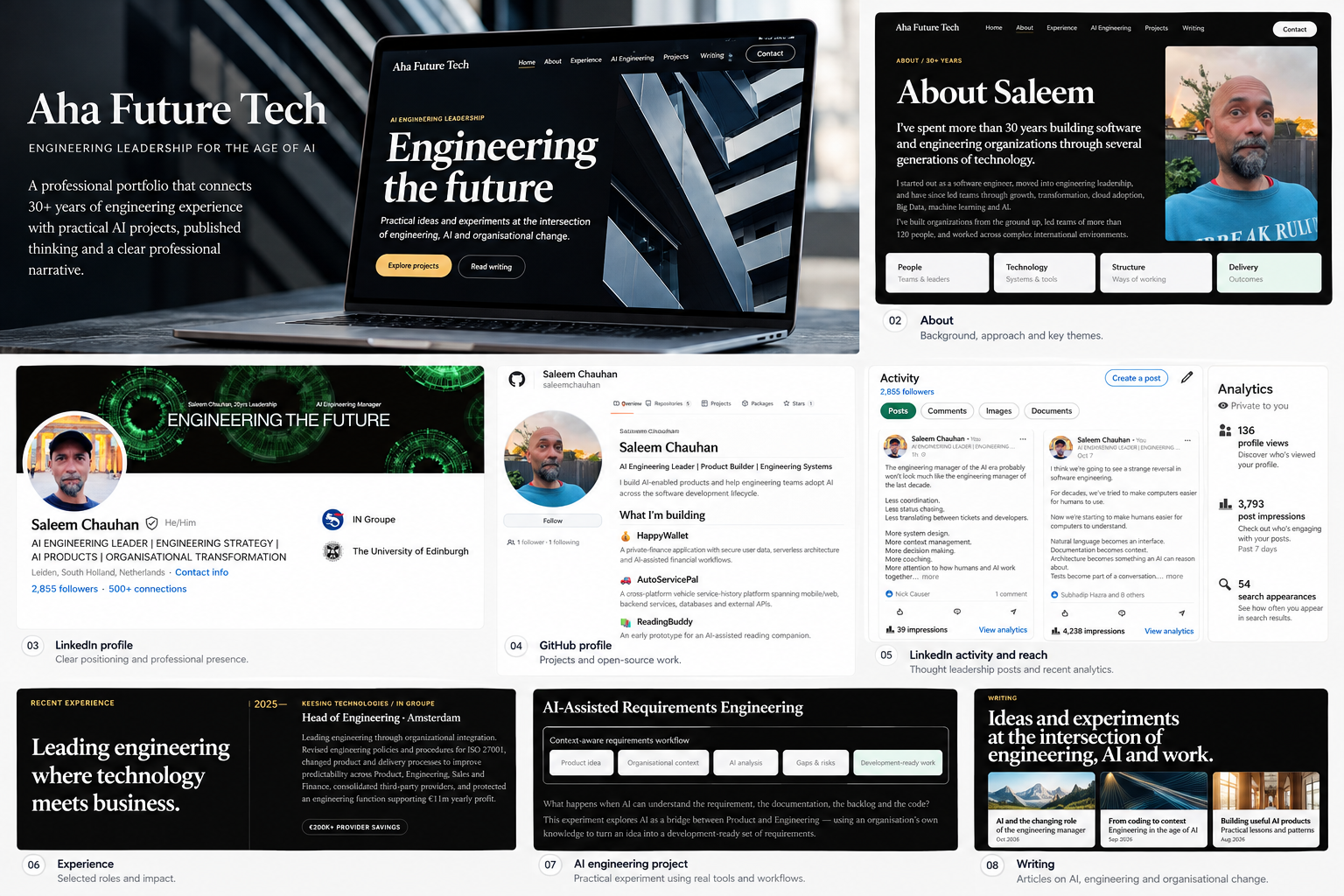
The principle is simple: discover the value in the work you’ve already done, make it visible, and build a system that keeps it working for you.